

Who is this for? Users with Administrator and Recruiter roles.
How Recruiters Run AI Coding Interviews | Hello Recruiter
Enabling It
If available on your account, you’ll see an AI-Assisted Coding toggle on the take-home round settings (see Adding a Take-Home Round). Turning this on means:- The candidate is given a provided AI coding assistant, instead of working entirely on their own
- Their AI conversation is recorded alongside their submitted files
- You get insight into how they used AI to solve the problem, not just the code they ended up with
- Each candidate gets a default AI usage budget
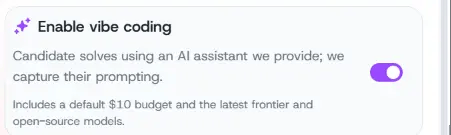
Enable AI-Assisted Coding toggle on the round settings
If you don’t see this toggle, it hasn’t been turned on for your account yet — contact your Hello Recruiter representative if you’d like it enabled.
How It Changes the Rubric
When this mode is on, the AI’s auto-generated rubric (see Shaping the Evaluation Rubric) adds a category covering how the candidate worked with the assistant, alongside your job’s usual criteria: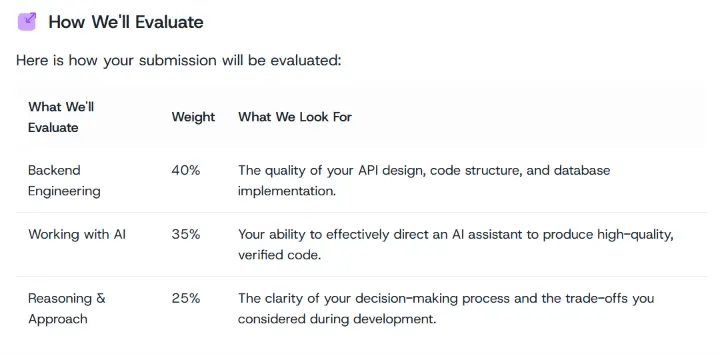
Example rubric for an AI-assisted take-home, including a "Working with AI" category
What the Candidate Sets Up
Candidates choose between an automatic setup (one command installs the assistant, their AI credential, and the problem statement) or a manual setup if they’d rather not run a script — both are covered in detail in the candidate guide. You don’t need to walk them through it; their assignment page includes the full walkthrough and the video above.Reviewing an AI-Assisted Submission
Once a candidate submits, open their profile and go to the Interview tab for the take-home round. Alongside the problem statement and submitted files, you’ll see a Prompting Session — a transcript of the candidate’s conversation with the AI assistant, including each turn, tool calls, model switches, and a timeline of the session.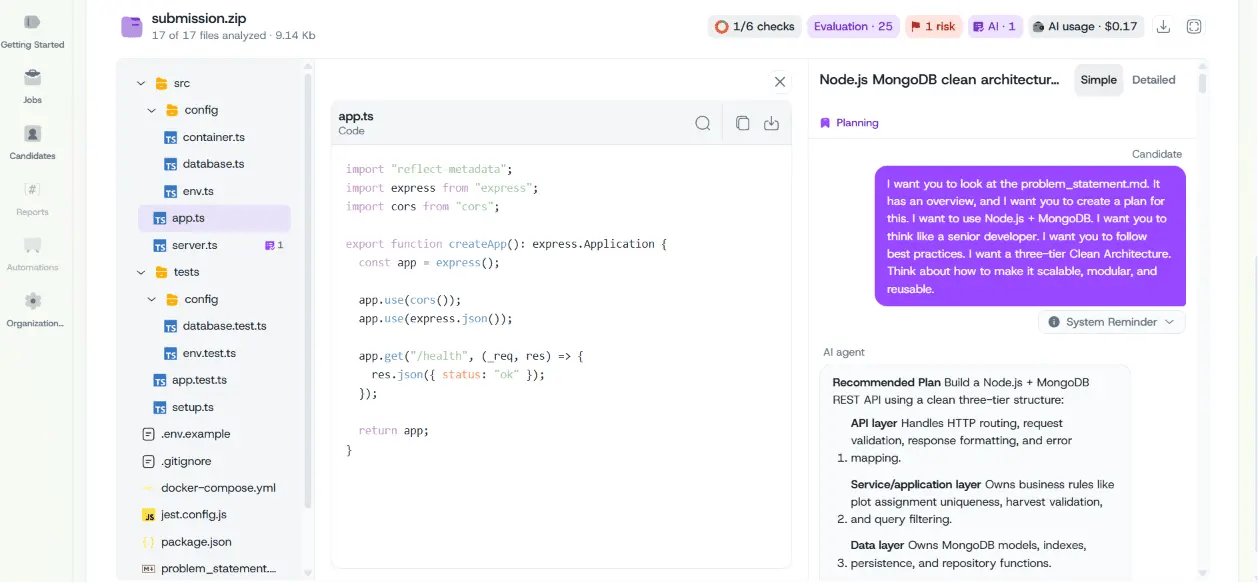
Assessment Analysis, showing submission files and the AI prompting session side by side
Understanding the Results
For AI-assisted submissions, the AI evaluates the candidate across two things:- Their code — same as a standard take-home: does it solve the problem, does it meet the requirements, is it well-built
- How they worked with AI — shown alongside the candidate’s other skill proficiencies on the Overview tab: how clearly they directed the assistant and how well they checked and corrected its output, rather than accepting everything it produced